
International Bamboo and Rattan Organization

International Bamboo and Rattan Organization

CHISHUI SUSTAINABLE LIVELIHOODS

China

2021
2024
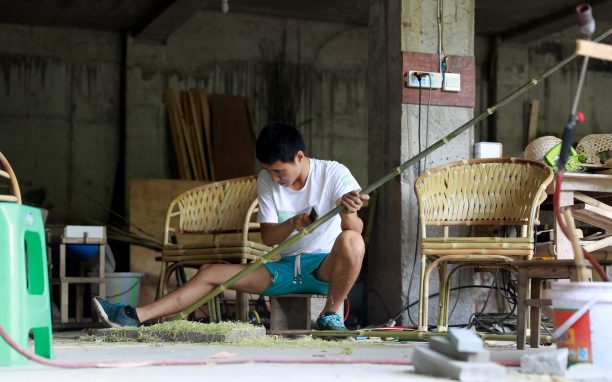
Credit: Wang Changyu

Donors

Chishui World Heritage Sustainable Livelihoods "Bamboo for Carbon Neutrality in Rural Area"

The development of sustainable livelihoods in Chishui World Heritage is one of the pilot activities within the framework of the UNESCO-led project “Conservation and Management of World Heritage Sites in China (Phase IV 2021-2024)”, which aims to strengthen culture-oriented, innovative and inclusive socio-economic development in China.

By taking bamboo-related green products and creative cultural handicrafts as the entry point, Chishui World Heritage Sustainable Livelihoods’ project will strengthen sustainable bamboo handicrafts production and capacity building through training centers and courses development. This will ensure both that bamboo handicrafts become accepted as a decent vocation and that more young people become involved, contributing in turn to rural revitalization and locally-based employment for the youth. In addition, it promotes the linkage between cultural and natural heritage and tangible and intangible heritage for sustainable development of local communities at the Chishui World Heritage site.

Objectives

The overall objective of this project is to enhance sustainable livelihood development of the local communities through strengthening local capacity building, pro-poor and green bamboo production in the Chishui region, especially focusing on enhancing Chishui’s capacity in the creative design of bamboo handicrafts. Furthermore, explore ways for the World Heritage site to develop both economically and socially within the framework of heritage conservation guidelines by using local bamboo resources.

Specific objectives:

  • Enhance the capacities of at least 50 local cooperatives and practitioners in creative design and marketing of bamboo-related handicrafts.
  • Facilitate bamboo-related handicrafts programs to be incorporated in local vocational education for the youth.
2021
  • 2021 project started.
  • The “Conservation and Management of World Heritage Sites in China” Phase IV by UNESCO and the China Youth Development Foundation Mercedes-Benz Star Fund was launched on 15 October 2021. As one of the pilot sites of this program, INBAR’s Chishui Sustainable Livelihood project was re-branded into “Bamboo for Carbon Neutrality in Rural Area.”
  • A preliminary database on the practitioners who engaged in bamboo intangible heritage in Chishui City has been established, of which 89% are women. The database would serve to carry out subsequent capacity-building activities of the project and facilitate mutual communication and cooperation among cooperatives and practitioners.
  • With the aim to promote the creative ability and expand the horizon of Chishui’s intangible heritage successors,  four bamboo-related handicrafts ICH bearers from the Chishui project have participated in the 11th China’s Bamboo Culture Festival and the first China’s Bamboo Intangible Cultural Heritage Exhibition and Contest, which was held on 19-21 October 2021 in Yibin, Sichuan province. 68 pieces of bamboo ICH handicrafts have been displayed at the Exhibition.
  • The first part of the Decent Employment Workshop “Bamboo for Carbon Neutrality in Rural Areas” was held on 1-30 December 2021 in Chishui. 25 women trainees have learned how to make creative bamboo weaving products. 10 trainees (40% of the total) have been employed in Chishui Hand in Hand Bamboo Art Development Co., Ltd. after the training.


2022
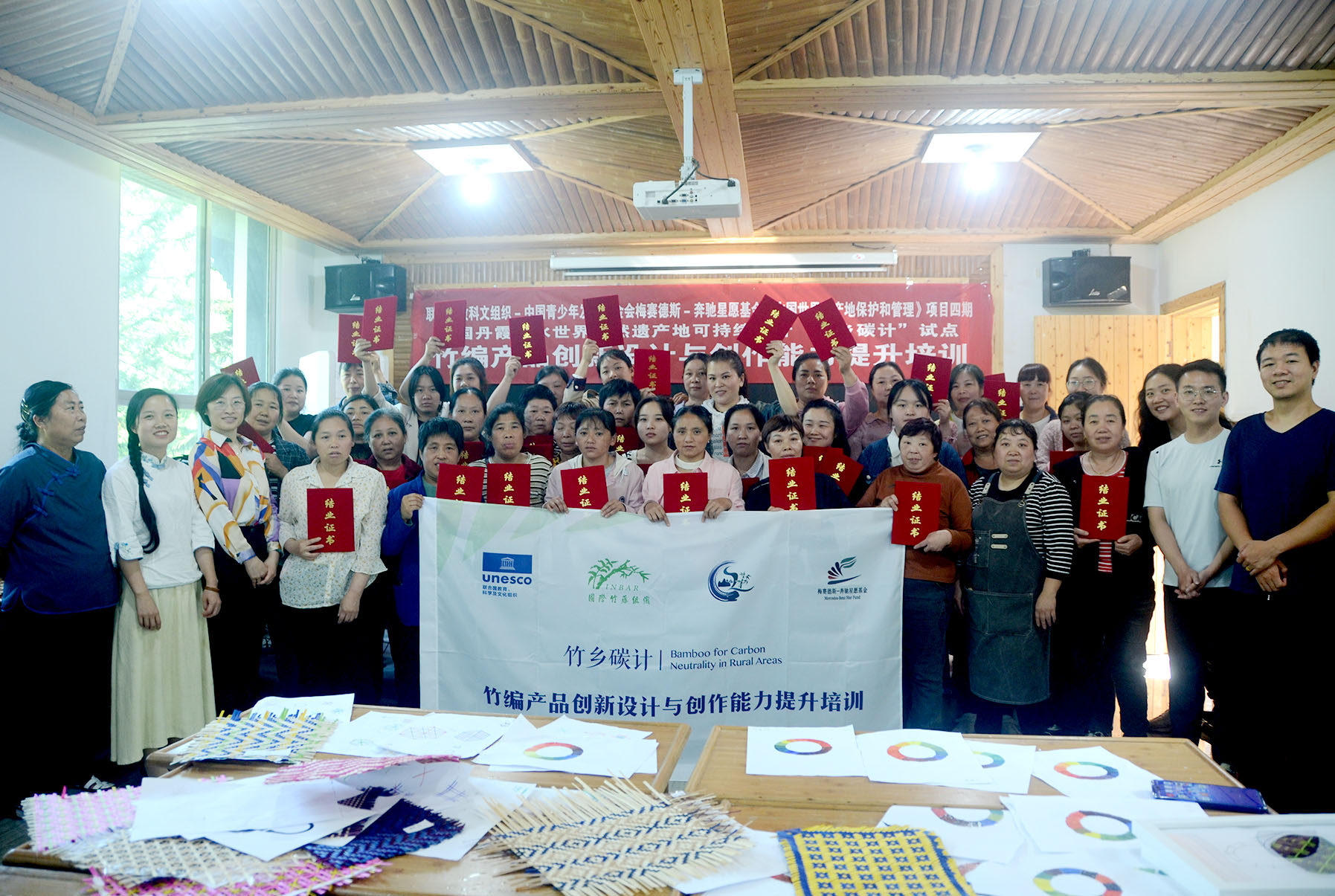
  • The second part of the Decent Employment Workshop, held from 13-27 April 2022 at the Jinxiu Community Poverty Alleviation Center, was focused on the bamboo weaving process and communication operations on social media. After 15 days of training, a total of 25 trainees (23 women and 2 men), including 1 relocated household and 1 registered poverty household, mastered the weaving techniques for seven bamboo products. More than 450 products have been produced by trainees during this period and a selection was directly purchased by the bamboo workshop.
  • The third part of the Decent Employment Workshop was held from 20 May to 3 June 2022 at the Jizhutang Intangible Heritage Bamboo Weaving Center in Datong Town. It focused on bamboo weaving skills and delicacy management to improve production, quality and efficiency. The training course combined teaching and order-oriented acquisition to enable the transformation from “craftsmanship” to “economy on fingertips.” A total of 25 participants (100% women), including 3 people from ethnic minorities, 1 registered poverty household, 1 relocated household and 1 disabled person, participated in the training course. The 16 trainees learned bamboo weaving on porcelain products, and a total of 2000 bamboo weaving products were produced, worth RMB 2400 (USD 335). Nine trainees learned flat weaving skills with a total of 150 m2 of flat bamboo weaving products produced, worth 1000 yuan (USD 140).
  • Establishment of a long-term training center. Jizhutang Intangible Heritage Bamboo Weaving Center in Datong Town has been selected as long-term bamboo-related craftsmanship safeguarding and transmission training center.  The training center will act as the incubating center to cultivate bamboo-related artisan and young talents and transfer the knowledge and techniques to local communities. The project team will provide technical assistance and financial support for the development of training courses at the center.
  • Development of training courses for bamboo-related crafts. A total of 8 short video clips of teaching course modules have been produced, covering the basic knowledge of bamboo material preparation, commonly used tools, weaving techniques, popular patterns and practical exercises to make bamboo weaving products.
  • The Call for Case Studies on “Bamboo for Carbon Neutrality in Rural Areas: Innovation and Practices in Carbon Reduction and Low-Carbon Development in and around World Heritage Sites”, jointly organized by UNESCO and INBAR from August to October 2022, aims to explore and share good ideas and practices of site management using bamboo, to encourage the civil society to gain awareness on the issues of carbon reduction and climate change, and to contribute to China’s efforts in attaining the “Dual Carbon Goals” (carbon peaking by 2030 and carbon neutrality by 2060). A jury panel consisting of 6 specialists with a diverse range of backgrounds evaluated the case studies based on criteria of innovation, practicality, exemplary in nature and adaptability, and viability and market potential. With careful evaluation of the collected cases by the jury panel, 15 case studies are granted as good practices or innovations and collectively documented into booklets of Collection of Selected Studies in Chinese and English, which demonstrate the breadth of potential that bamboo has on sustainable development of protected areas, innovative nature-based solutions worthy of further exploration, and the good practices of World Heritage sites and Hometown of Bamboo in China in promoting low-carbon development that we could draw important lessons from.
  • On 8 November 2022, INBAR and UNESCO co-hosted a technical session on “Bamboo for Carbon Neutrality in Rural Areas: New Pathways for Carbon Reduction and Low Carbon Development in World Heritage Sites ” during the 2nd Global Bamboo and Rattan Congress (BARC 2022) held in Beijing, China. As one of the “New Horizons of Heritage Conservation” webinar series as well, the session discussed the role of world heritage in mitigating climate change, explored how to create a low-carbon and sustainable environment, boost low-carbon cultural tourism, embed heritage education and value dissemination, pursuit “harmony between humanity and nature”, and promote the implementation of 2030 sustainable development agenda.
  • Coordinated the collection of 17 pieces of bamboo weaving products from the intangible cultural heritage inheritors in Chishui, and displayed the collection at the UNESCO booth during the China International Fair for Trade in Services (CIFTIS) in September 2022 to improve the public’s understanding of bamboo weaving intangible cultural heritage skills, sustainable management of world heritage and its impact on livelihood development.
  • On 11 October 2022, on the invitation of the local partner, the INBAR project manager participated virtually in the issuance ceremony of Guizhou’s first bamboo forest carbon ticket and Chishui Danqing carbon ticket, and introduced the project concept of “Bamboo for Carbon Neutrality in Rural Areas” during the ceremony. The first Chishui Danqing carbon ticket worth 50 million yuan was successfully released during the event. The carbon ticket is developed based on a carbon stock of 1.04 million tons from 100,000 mu of bamboo forest in Chishui within the accounting period from 2016 to 2020. A credit facility agreement was entered between Chishui Rural Credit Union and Chishui Shengfeng Group for the development of bamboo forest carbon credit projects. In addition, Chishui Forestry Bureau and Chishui City Running Association respectively subscribed for compulsory tree planting carbon offsetting tickets, Shengfeng Group subscribed for carbon offsetting tickets for meetings, while Chishui Power Supply Bureau, Chishui City Wanglong Qianjin Quarry, Taisheng (Guizhou) Bamboo Resources Development Co., Ltd. subscribed Chishui Danqing carbon ticket for offsetting.
  • Chishui community leaders, living heritage bearers and craftspeople have participated 2022 Online Capacity Building Workshops on Heritage Communication for World Heritage Sustainable Livelihood Pilot Sites on 19 November and 3 December 2022, which is under the Heritage So Young initiative jointly organized by UNESCO and Communication University of China.
2023
  • The project facilitated the participation of representatives from Chishui, who are inheritors of intangible cultural heritage, in the Second Capacity Building Workshop on Living Heritage for Rural Revitalization. This workshop took place from 17 February to 3 March, at Suzhou Arts and Crafts Vocational and Technical College within the framework of UNESCO – China Youth Development Foundation Mercedes-Benz Star Fund “Conservation and Management of World Heritage Sites in China” Project Phase IV. The training course focuses on targeted skills improvement for intangible cultural heritage technology leaders who have production, management and marketing capabilities in each pilot area under the project. The training courses consisted of thematic lectures on innovative crossover product design, development of useful items, high-end handicraft or art pieces and corporate branding, as well as extensive hands-on tutoring on designing and innovating cultural and creative product samples with distinctive local ICH elements and characteristics. A total of 4 trainees (Liu Hongxia, Li Deqiang, Mou Xiaoyan participated online, Tian Yajia) from Chishui signed up to participate.
  • On 22 May 2023, INBAR organized the Bamboo Forest Carbon Sink Management Training Course at Chishui National Bamboo Industrial Demonstration Park in Chishui City. The training aimed at strengthening the capacity of local forest officials, technicians and relevant stakeholders on bamboo forest carbon sink management by introducing the basic theoretical knowledge and practical cases on the development of bamboo afforestation carbon projects or via improved management, landscape-based (bamboo) forest carbon planning, assessment, potential mapping and management at county level.  A total of 66 trainees involved in forest carbon sink development and trade management, attended the training, including 56 men and 10 women, which was far more than the original planed of 10 trainees.  Thanks to this capacity building, the trainees are equipped with basic knowledge of bamboo forests for carbon neutrality, this will serve as a threshold for further exploration and development of bamboo forest carbon projects, carbon potential assessment, monitoring, and planning for carbon-oriented bamboo forest management.
  • On 25 May 2023, INBAR and UNESCO jointly organized an online sharing session on Selected Case Studies on the Innovation and Practices in Carbon Reduction and Low-Carbon Development in and around World Heritage Sites. 14 representatives of selected outstanding cases have shared their specific practices and innovative ideas, which show bamboo’s potential in sustainable development of world heritage sites, and provide innovative nature-based solutions worthy of further exploration and valuable reference for other world heritage sites and bamboo hometowns in pursuit of low-carbon development. A total of 87 participants, including 51 women and 36 men, registered for the sharing session. The event brought together individuals from diverse professional backgrounds, fostering interdisciplinary, constructive, and innovative discussions on carbon reduction and low-carbon development.
  • INBAR is developing a leaflet on China’s Bamboo Intangible Cultural Heritage and Innovation in Bamboo Weaving, which elaborates relevant knowledge and step-by-step technical guidance on bamboo-weaving techniques, skills, patterns, design, product innovation and marketing tools. Along with the leaflet, twelve video tutorials (available in INBAR WeChat and YouTube channels) to assist readers in learning and making with their hands Chishui bamboo weaving.
  • Guidelines for Green and Low-Carbon Consumption at World Heritage Sites in Chinese and English also developed, which introduces the concept and pathway of green and low-carbon consumption through bamboo products at World Heritage sites in China
2024
  • From 28 April to 2 May 2024, a public event themed “Green and Low Carbon Consumption at a World Heritage Site” was co-hosted by INBAR and the United Nations Educational, Scientific and Cultural Organization’s (UNESCO) Regional Office for East Asia, with implementation support from the Chishui Forestry Bureau. The event took place at two locales: 1) the Chishui Danxia World Heritage Site; and 2) the Xiangzhanglin Square of Chishui City. The goal was to advocate for green and low-carbon consumption, actions and lifestyles with environmentally friendly bamboo products. (Teaming up with UNESCO for sustainable consumption | International Bamboo and Rattan Organization (inbar.int))
  • From 22 to 26 April 2024, a training workshop was held at Jizhutang Training Center in Datong Town, Chishui, China. The workshop on Capacity Building on Innovative Pattern and Product Design of Bamboo Weaving was co-organized by INBAR and the United Nations Educational, Scientific and Cultural Organization (UNESCO), with implementation support from Chishui Forestry Bureau and Jizhutang Training Center. The objective was to promote the development of creative bamboo-woven products and the application of bamboo-weaving patterns and innovative design. (‘Weaving’ the traditional with the modern in Chishui | International Bamboo and Rattan Organization (inbar.int))
  • From March 20 to May 20, 2024, the Youth Education Program: Empowering Youth for Bamboo Weaving ICH Techniques was successfully conducted at Chishui Secondary Vocational School and Lu Huaying Bamboo Art Master Studio of Zunyi Vocational and Technical College. The Youth Education Program was organized by INBAR and UNESCO, with implementation support from Chishui Shendiao Bamboo Art Factory and Chishui Secondary Vocational School. A total of 320 students from 8 classes of the first and second grades of Chishui Secondary Vocational School and 16 classes of Zunyi Vocational and Technical College participated in the Youth Education Program, including 87 men (27.2%), 233 females (72.8%), and 26 ethnic minority students (8%, from 7 ethnic minorities, namely Tujia, Dong, Miao, Buyi, Yi, Shui, and Mongolian).
Contact Details

For more information about the project, please contact:

Yanxia Li, Senior Programme Officer, yxli [at] inbar [dot] int

Partners


UNESCO


Chishui Forestry Bureau

Project News

Project Events

Project resources

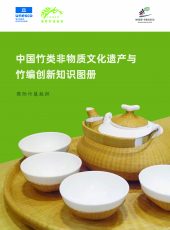
China’s Bamboo-Related Intangible Cultural Heritage and Innovation in Bamboo Weaving

This Booklet focuses on introducing Chinese bamboo weaving to allow readers t...

中国竹类非物质文化遗产与竹编创新知识图册

在本图册的编写过程中,我们将中国竹编作为了重点介绍对象,以期读者能够在了解中...

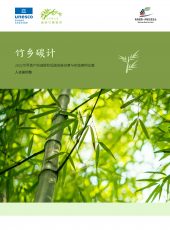
Bamboo for Carbon Neutrality in Rural Areas: Collection of Selected Case Studies

China is home to 56 World Heritage Sites which play an important role in help...

竹乡碳计:入选案例集

入选本册的15份案例展示了竹子在中国世界遗产地和竹乡可持续发展方面的广泛潜力,...

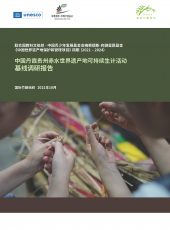
世界遗产地绿色低碳消费指南

本手册是中国丹霞赤水世界遗产地可持续生计项目(竹乡碳计)的内容之一。竹乡碳计...

Guidelines for Green and Low-Carbon Consumption at World Heritage Sites

This manual is one of the deliverables of the Chishui World Heritage Sustaina...