News
News‘Weaving’ the traditional with the modern in Chishui
Workshop conjoins traditional bamboo-weaving skills with modern aesthetics to help transform livelihoods for rural women.
From 22 to 26 April 2024, a training workshop was held at Jizhutang Training Center in Datong Town, Chishui, China. The workshop on Capacity Building on Innovative Pattern and Product Design of Bamboo Weaving was co-organized by INBAR and the United Nations Educational, Scientific and Cultural Organization (UNESCO), with implementation support from Chishui Forestry Bureau and Jizhutang Training Center. The objective was to promote the development of creative bamboo-woven products and the application of bamboo-weaving patterns and innovative design.

Li Yanxia, Senior Programme Officer, speaking at the opening ceremony.
Several high-level figures convened the opening ceremony, including Ge Jihong, Vice Mayor of Chishui City; Li Yanxia, Senior Programme Officer and Project Leader of INBAR; Wang Xiaowei, Deputy Director of Chishui Forestry Bureau; Huang Lin, Deputy Mayor of Datong Town; Jia Honggang, Community Director; and Yang Changqin, Head of the Jizhutang Training Center.
In addition to these officials, Professor Shah, Director and Representative of the UNESCO Multisectoral Regional Office for East Asia, also delivered a video message, emphasizing that the Chishui pilot project strengthens the role of culture and creativity in sustainable livelihood development, and that this training activity on design innovation is essential for transforming intangible cultural heritage artifacts into a source of decent and sustainable livelihoods for local communities. Vice Mayor Ge Jihong gave a speech, expressing his gratitude to the project for its strong support for the rural revitalization of Chishui, and pointed out that the training was rich in content with a strong emphasis on technology, which will help enlighten students’ artistic accomplishments, build additional income streams, and also help transmit the intangible cultural heritage of bamboo weaving. Li Yanxia also spoke, introducing the overall Chishui project, as well as its goals and objectives, and the arrangement of related training activities.
Utilizing both lectures and hands-on practice, the five-day workshop was broken into three thematic sections, including 1) the introduction of relevant tools to modern design; 2) practical exercises of bamboo-weaving innovation and product design; and 3) product marketing and promotion. By addressing shortcomings in the innovative design of bamboo-woven products in Chishui, the workshop aimed at strengthening the inheritance and development of bamboo weaving in Chishui through improving the capability of bamboo-weaving practitioners or inheritors in innovative design and inspiring their creativity on the unbounded potential of bamboo-woven products.

Students were given hands-on instruction with designing and weaving.
The workshop was implemented by six professional teachers with backgrounds in modern design. Four local bamboo-weaving practitioners in Chishui were also invited, and in total 36 local women participated in the event. The trainees were mainly composed of students, community leaders, bamboo art inheritors, young people and community practitioners with basic related skills and/or knowledge.
After five days of training and practices, the trainees had learned a great deal about the applications of innovative modern design principles in traditional bamboo-weaving. They had also mastered basic bamboo weaving skills and knowledge on modern design and product innovation while also developing products adapted to the needs of the modern life and current market trends. This process injected new vitality into bamboo-weaving techniques and product development.
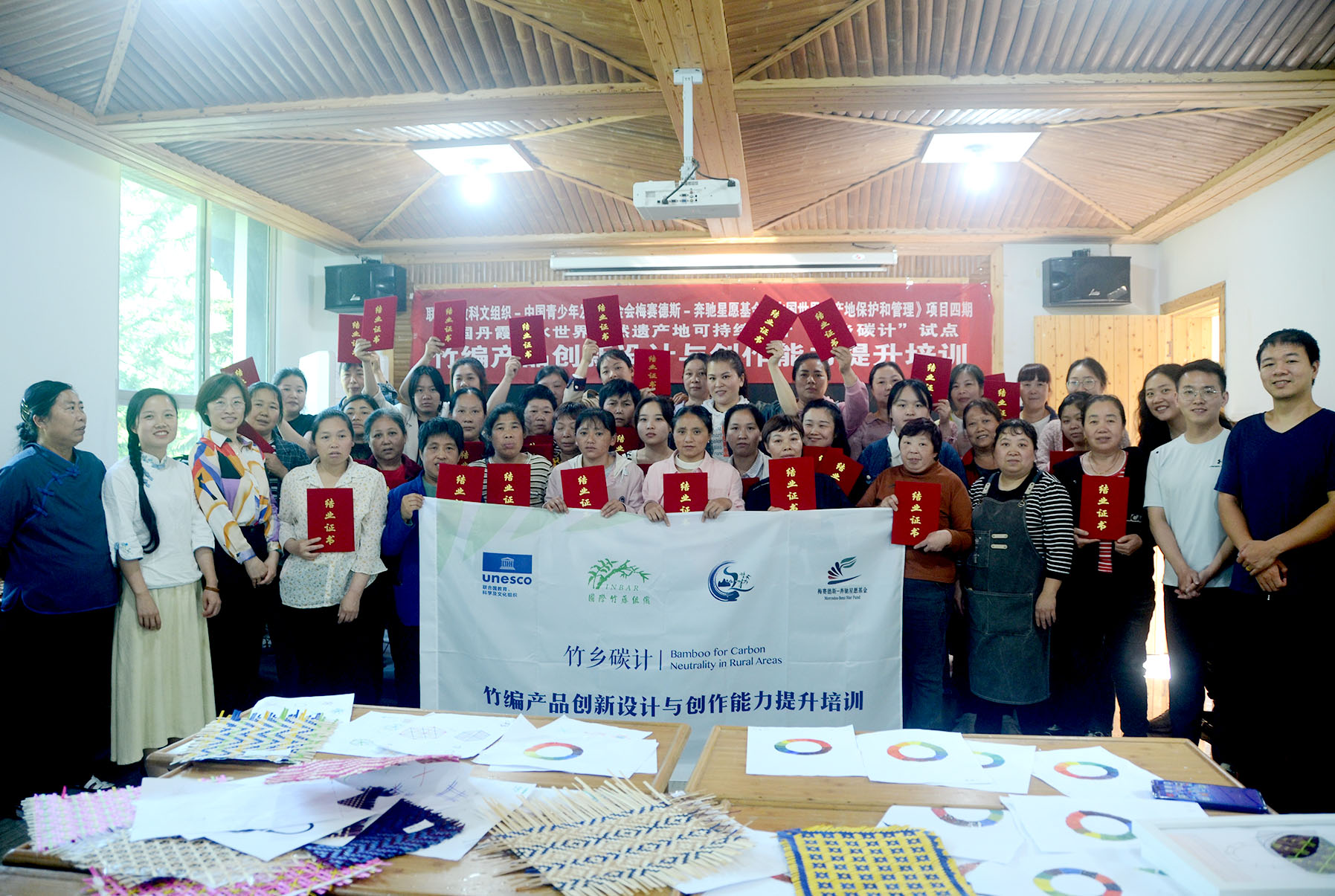
At the time of completing the practical hands-on activities organized as part of the workshop, the trainees had created more than 150 bamboo-woven pieces that fused traditional charm with modern aesthetics. At the closing ceremony of the workshop, some participants shared their creative ideas, processes and experiences, while trainers provided comments and feedback. Zeng Yunheng, Culture Officer of the UNESCO Office for East Asia, also attended the closing ceremony.

Students displaying their final design products from the training.