 News
NewsWeaving better livelihoods with bamboo mats

Could bamboo mats help rural communities prosper? A workshop in Ethiopia aimed to accomplish just that.
The production of bamboo mats is becoming an increasingly lucrative source of rural household income in the Sidama Region of southern Ethiopia. The woven mats produced in the region are primarily used for drying coffee beans in the coffee production industry. The mats also have additional uses in the construction of housing and fencing.
According to the Regional Bureau of Forest Environment Protection and Development, approximately 1250 truckloads of bamboo mats are produced annually in the Arbegona district of Sidama, utilizing 1.25 million highland bamboo (Yushania alpine) poles annually. The business turnover is estimated at approximately USD 1 million, derived from the sale of bamboo mats in domestic markets. The industry is responsible for generating employment opportunities for upwards of 65,000 rural people, including women and youth.

In order to strengthen the livelihoods of local communities and create additional employment opportunities for young people and women, INBAR has undertaken a collaborative project with the Spanish Agency for International Development Cooperation (AECID) on “Building a circular economy and climate change resilience through bamboo supply chain development in Ethiopia.” The project aims to reinforce the supply chain in accordance with upgrading the value chain, thereby facilitating the production of market-driven products.
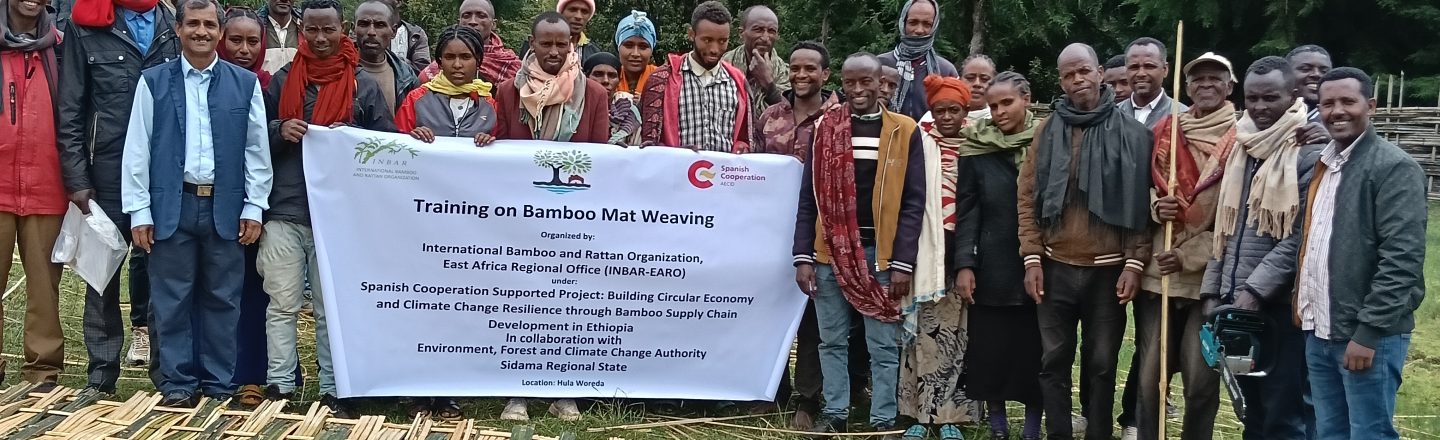
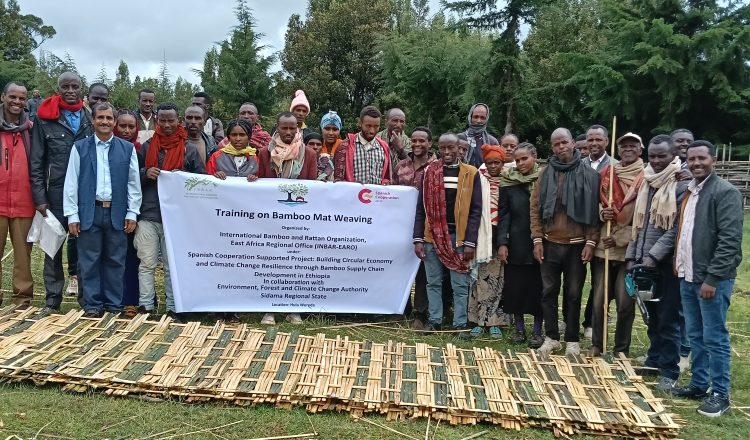
A training program on bamboo mat weaving was recently organized by project implementers, with the objective of strengthening the overall value chain. The training engaged 31 youth and women in Hula Arbegona, located in the Sidama Region. The training module introduced ideal process flow, including jigs and tools, to enhance the efficiency of producing bamboo mats. On a practical level, disseminating this knowledge will help producers increase the volume of their product and widen profit margins.
In addition, the producer-to-business (P2B) approach was demonstrated to existing buyers and members of a bamboo cooperative for sustainable business linkages. Currently, bamboo mats are produced as high-volume, low-value products in the value chains. In near future, there is serious potential for bamboo mats to be transformed into a high-value-added engineered product through the encouragement of medium- and large-scale investors in the sector.