News
NewsINBAR and partners advance bamboo construction in Ghana

Orientation program for international students highlights bamboo’s sustainable advantages to traditional building materials like concrete and steel.
On 3 September 2025, INBAR’s West Africa Regional Office (WARO) hosted an orientation program for international architectural students from the Karlsruhe Institute of Technology (KIT, Germany) in Accra, Ghana. The orientation was held as as part of the 2025 Reinterpretation Natural Building Material-RENABUMA Ghana Co-Lab Workshop, a three-week intensive international program running from 1 to 23 September 2025.
This unique exchange brought together students, researchers and practitioners from Kwame Nkrumah University of Science and Technology (KNUST, Ghana), KIT and INBAR WARO to co-create ideas for a more resilient and circular built environment.

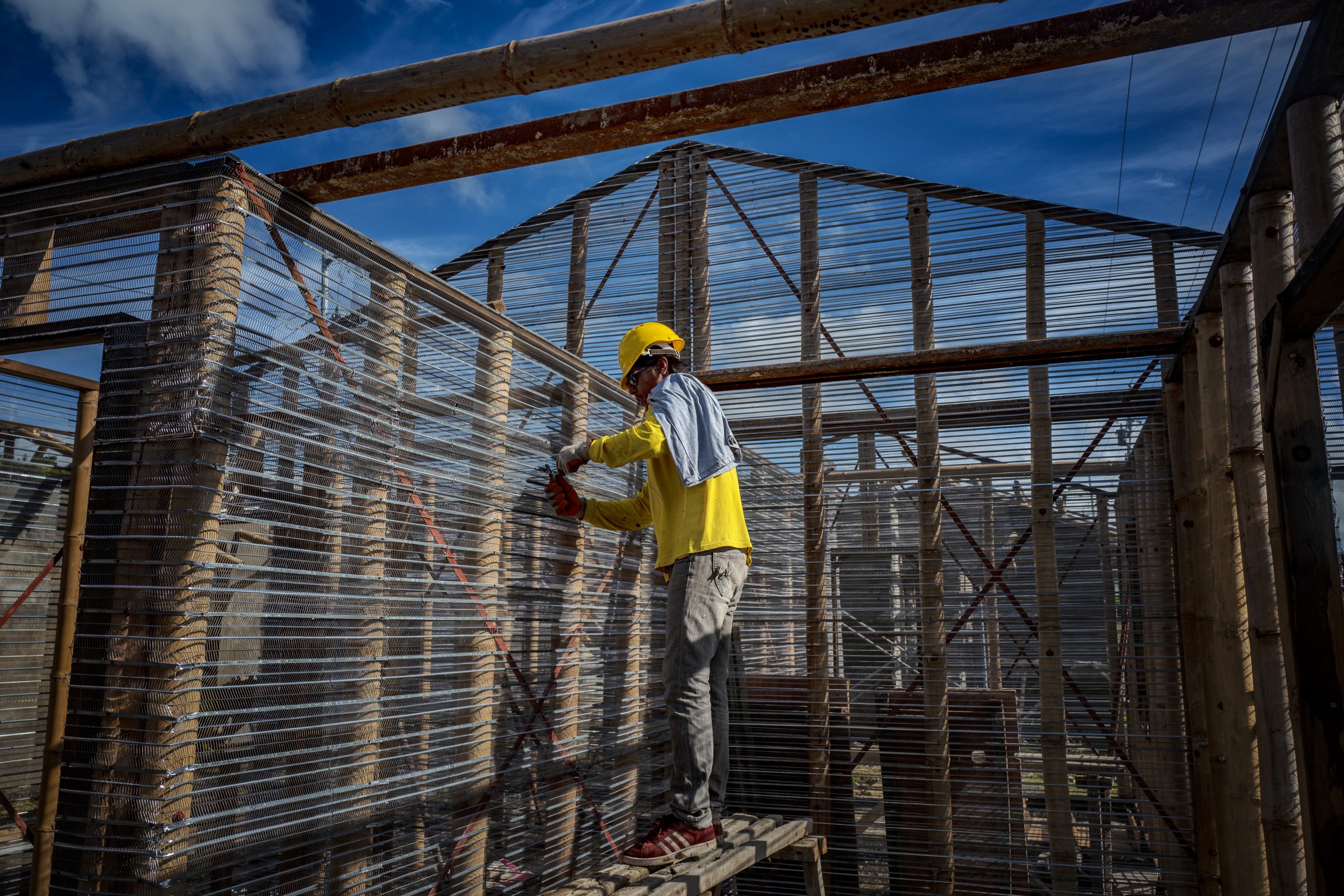
The orientation was led by Michael Kwaku, Acting Regional Director at INBAR WARO. Highlighting the strategic role of INBAR in promoting bamboo and rattan in Africa, Kwaku reiterated the importance of bamboo construction in Africa, highlighting how it offers a sustainable and cost-effective alternative to traditional materials like concrete and steel, with benefits including affordable housing, carbon sequestration and job creation. “The outcomes of the workshop should be transferred to local communities, enabling them to replicate or build their own houses as a way of adopting, improving and sustaining new technologies and skills,” he said. He further urged the students to model their bamboo designs and ideas using local materials and knowledge for easy adoption and scaling up.
Professor Moritz Dörstelmann, who led the international student delegation from KIT, expressed his deep appreciation to INBAR for hosting the event. In the near future, INBAR and KIT are set to collaborate on the co-development of a bamboo construction project in Ghana after the workshop ends.

At the same time, the longstanding collaboration between INBAR WARO and the Department of Architecture at KNUST in promoting research and development of bamboo construction in Ghana has played a key role in developing national and international projects.
A wide range of organizations have now expressed interest in helping to establish a Global Bamboo Housing Program, including KIT, Hochschule RheinMain, the United Nations Educational, Scientific and Cultural Organization, the Technology Consultancy Center for Innovation, Manufacturing, Technology Transfer and Entrepreneurship, and the Ghana Institute of Architecture. This robust support creates opportunities for its development across Africa, Europe, Asia and Latin America. As institutions around the world continue to gain interest in bamboo’s applications in construction, INBAR WARO looks forward to coordinating the Global Bamboo Housing Program in Ghana and across Africa.