News
NewsTowering bamboo, towering mountains: The Third Mountain Futures Conference

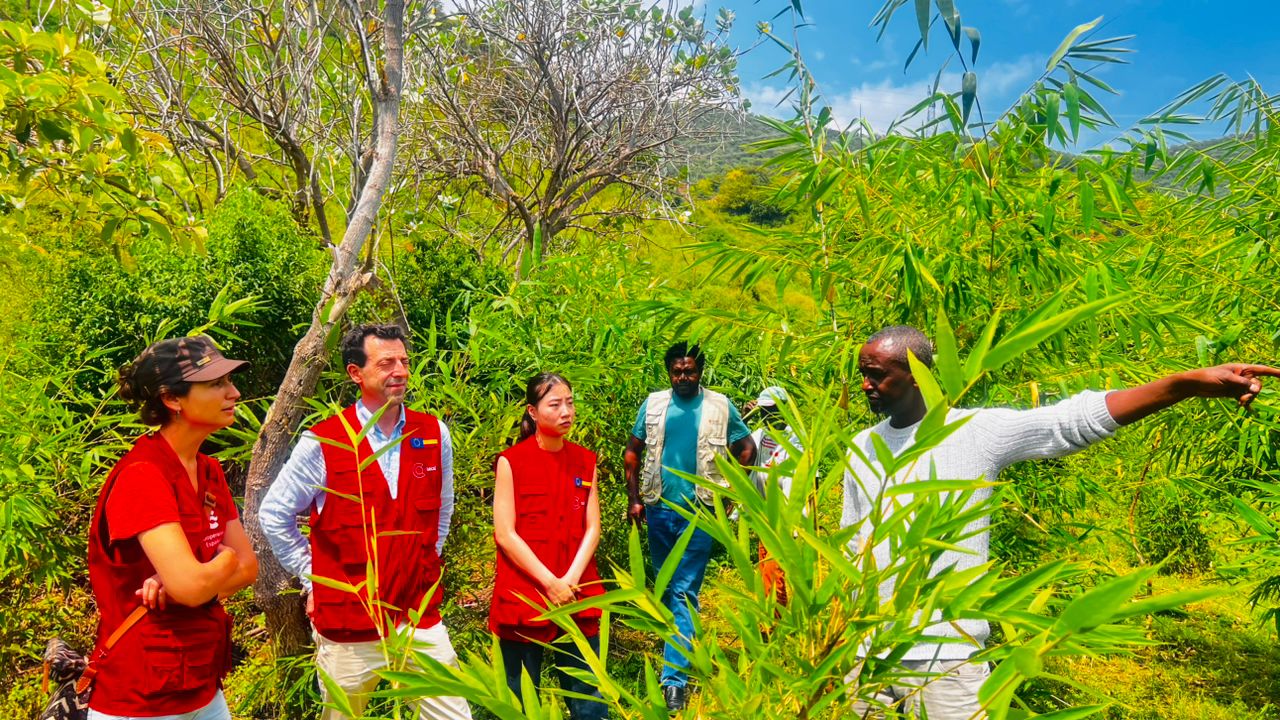
Mountain communities are repositories of deep ecological knowledge. Credit: ICRAF
Landmark conference on sustainable mountain stewardship seeks to guide policymakers and influence future legislation for the world’s “water towers.”
Mountains cover 25% of land on earth, providing essential resources and ecosystem services for sustaining life such as fresh water, clean air, forests, habitats for biodiversity and minerals while holding cultural and spiritual significance for communities. Many of the world’s Indigenous peoples have built their livelihoods on mountainsides for millennia and possess rich ecological knowledge. However, mountain ecosystems and local people are highly vulnerable to impacts from climate change, natural hazards, food insecurity, land degradation, biodiversity loss and more.
A landmark conference is hoping to draw upon the wisdom of these mountain inhabitants while devising forward-thinking, nature-based solutions to strengthen livelihood resilience. From 16 – 18 April 2023, the Third Mountains Future Conference: Mountain Communities in the Kunming-Montreal Global Biodiversity Framework convened in Kunming, Yunnan Province, China.

Participants gathered at Kunming’s World Expo Horti-Garden to meet and outline a “Roadmap for Mountain Futures” to positively steer mountain development. Credit: Centre for Mountain Futures.
Launched to support the 15th Conference of the Parties to the Convention on Biological Diversity, the conference revolved around four main themes: Scientific Exploration, Ecological Restoration, Indigenous Wisdom, and Future Living. A range of plenary and parallel sessions, workshops and exhibitions were organized to highlight innovative sustainable development in mountain regions.
INBAR vigorously participated in the conference, attending sessions across all of the main themes. Several of the presentations discussed the role of bamboo in natural environments, focusing on its role for facilitating biodiversity and its potential for development and conservation efforts.
Future Living session: The role of bamboo in the mountains

Belay presented at the Future Living session and also gave closing ceremony remarks on behalf of INBAR. Credit: Centre for Mountain Futures.
Tefera Belay, INBAR Program Development Officer, gave a presentation at the Future Living session on the Role of Bamboo for Ecological Restoration and Ecosystem Service Generation for Mountain Societies of Tropical and Subtropical Regions. Reservoirs of valuable fauna and flora species in mountainous regions of Africa, Asia and Latin America, bamboo forests play an important role in replenishing soils and providing ecosystem services. Bamboo forests also act like giant sponges, sequestering carbon, and play a positive role in improving hydrological cycles. His presentation included case studies that highlighted the inherently beneficial characteristics of bamboo, such as its long-fibrous root system, soil-binding properties, dense litter layer for retaining moisture, ability to grow on degraded soils and steep slopes, as well as its extremely fast growth rate and canopy formation.
The plant can revegetate even the most damaged soils within a short period of time. In Allahabad, India, severely degraded soil – the result of an intensive brickmaking industry – showed remarkable recovery after planting with bamboo, increasing the groundwater table by 10 meters in just 20 years. In Chishui, China, bamboo plantations had 25% less water runoff than adjacent sweet potato farms. In Nepal, one plantation helped reduce soil erosion and flood damage, and in Ghana bamboo is being used to restore degraded mining sites. It also fosters conditions for the growth and rehabilitation of many tropical species that grow alongside it as part of the understory or functional components of the overstory.
Bamboo has also provided tremendous socioeconomic opportunities, capable of being used for fiber, medicine, food and raw material for making furniture, handicrafts and structures. In Tanzania, bamboo-related enterprises have generated an estimated extra USD 200 every month per household, creating jobs for almost 1000 villagers. In Ethiopia, over 750,000 households depend on bamboo for their livelihood. In Anji, China, the bamboo shoots industry generates around USD 2 billion a year, attracting over 8 million bamboo-based ecotourists annually.
Bamboos’ ecological suitability complemented by its versatile array of ecosystem services make it an ideal choice for environmentally and socially acceptable land restoration schemes.
Bilateral meetings
In addition, activities were held to expand new and strengthen existing partnerships across INBAR’s network, including bilateral meetings with:
- Sara Manuelli, Advocacy Officer of the Food and Agriculture Organization (FAO) Mountain Partnership Secretariat
- Professor Yi Shaoliang, Transboundary Landscapes Programme Coordinator of International Centre for Integrated Mountain Development (ICIMOD)
- Surendra Joshi, Senior Resilient Livelihood Specialist and Head of ICIMOD’s Living Mountain Lab
- Catherine W. Muthuri, Country Coordinator for Kenya and Regional Convener, East Africa (CIFOR-ICRAF)
- Professor Xu Jianchu, Director of Centre for Mountain Futures (CMF)
- Professor Zhao Yihe, Director of Forestry Industry Research Institute of Yunnan Academy of Forestry and Grassland

From left to right: Dr. Surendra Joshi, Prof. Yi Shaoliang, Jin Wei, Prof. Xu Jianchu, Catherine W. Muthuri, Tefera Belay, Dr. Dossa G. G. Olawole, Leeney Zhou. Credit: Centre for Mountain Futures.
In these meetings with key representatives from other organizations, INBAR made the case for bamboo and rattan as essential forest resources that deliver a suite of benefits capable of helping organizations achieve their strategic goals. Growing largely across the Global South, which is home to numerous mountain landscapes that are now imperiled by a range of factors, bamboo can function as a solid buttress capable of safeguarding communities and bolstering resilience.
In particular, new opportunities were explored with like-minded allies for integrating the Bamboo as a Substitute for Plastic Initiative with other planning schemes, like the Mountain Futures Initiative, while also reaching consensus on the need to cooperate across key themes like product labeling and trade, combining resources for women empowerment in mountainous areas, and engaging in joint-project development.

INBAR Capacity Manager Jin Wei also spoke at a session. Credit: Centre for Mountain Futures.
Closing ceremony remarks
At the end of the conference, Belay also gave the closing ceremony remarks on behalf of INBAR Deputy Director General Lu Wenming. In his speech, he briefly introduced the scope and intergovernmental mandate of INBAR, while outlining some of the main contributions of bamboo and rattan to mountainous areas. These included their cultural significance across Africa, Asia and Latin America; ecological importance for providing food and shelter to pandas, gorillas, birds and reptiles as well as numerous other organisms; and socio-economic potential owing to their fast growth, renewable credentials, diverse applications and material properties.
INBAR will continue to facilitate synergistic South-South cooperation to fortify mountain communities and ecosystems. As part of the process, INBAR works with policymakers across its Member States to streamline bamboo and rattan into strategic planning and programmatic work to achieve the targets set under the Post-2020 Biodiversity Framework. Given that INBAR has Memorandums of Understanding with many of the conference partners, the Government of China and INBAR’s Bamboo as a Substitute for Plastic Initiative can now be leveraged to effect positive changes for mountain stakeholders everywhere.
Post-conference field trip to Honghe County
Afterward, some attendees continued on with the field trip portion of the conference. Traveling to Honghe County, Yunnan Province, a three-hour drive from Kunming, the visitors were brought to the Mountain Futures Demonstration Centre.

CMF is restoring the degraded slopes of Honghe using an integrated agroforestry system.
At the demonstration site, Xu introduced them to the surrounding fields, showing the wide variety of species under cultivation such as Calotropis gigantea (giant milkweed), Sesbania cannabina (yellow pea bush), sorghum, hybrid corn and a lemon variety (Rosso) as well as other mountain fruits, vegetables and edible flowers.
INBAR was invited to join in the construction of the integrated agroforestry system in the hot, dry valley of Honghe. Bamboo can play an especially important role in the region for water and soil conservation, livelihood generation as well as in restoring the degraded landscape.

Conference participants at the Mountain Futures Demonstration Centre in Honghe.
After their visit to the demonstration site and surrounding fields, they next traveled to Longpu Village, a community known for its bamboo weaving, where participants met with villagers and local government officials to discuss the current status of bamboo development. Nestled 1750 meters in the upland terrain, the remote village has just 3000 inhabitants and features a large temperature disparity between night and daytime.
Most of the residents of the village belong to the Yi minority ethnic group, who have their own distinct 400-year-old history of traditional bamboo weaving. To help build capacities, increase bargaining power and raise profits, they established a local bamboo weaving association in 2013, which now boasts 187 members. Their main bamboo products are hats, food containers and furniture. Private-public linkage has helped bring capital and training resources into the area, which has allowed the village association to expand its product line into tea containers and other packaging to reach outside markets.

Locals are mostly Yi, one of the largest ethnic minorities in Yunnan, China.
In China’s Yunnan Province, approximately 38% of the population belongs to an ethnic minority. This makes the province one of the most ethnically diverse regions of the entire country. In addition, Yunnan features extreme topography, with highlands in the northwestern Tibetan region soaring well over 3000 meters and lowlands on the border of Viet Nam plummeting to near sea level. The natural environment fosters a vast array of endemic biodiversity to accompany the cultural richness of the province.

Woven bamboo product made by the members of the local association.
Diverse mountain regions like Yunnan tend to have unique challenges for implementing sustainable development. In Longpu Village, four key issues were identified in need of addressing for helping the village grow its bamboo weaving industry:
- Product types are limited. Quality control remains an issue and techniques are outdated;
- Tools and equipment are lacking. Poor design and weak marketing complicate promotional work;
- Uncoordinated planning. The local government is introducing bamboo for producing shoots, but villagers prefer more support for scaling up the bamboo weaving industry and entering more lucrative markets; and
- Unequal gender norms. Older women comprise most bamboo laborers, and most men and youth have left the village. Women also lack social and economic status compared to male villagers.
Through meeting with Su Yufang, Professor of CMF, and local government officials, INBAR explored the possibility of collaboration for addressing some of these issues. Targeted training could fill in key gaps in the area by equipping stakeholders with modern skills and knowledge for producing high-quality woven bamboo products. If this leads to an increase in income levels, it could potentially attract more village youth to contribute to the local economy rather than move out for part-time laboring opportunities that tend to pay more than village jobs, improving both the local economy and overall social development of the area.
Only time will tell if Longpu Village can overcome its obstacles and rise to the challenge. But bamboo is a towering ally in the fight for sustainable development. INBAR will strive to let it flourish even in the remote mountain regions of the world.