News
NewsWomen leaders poised to spread bamboo across Ghana

The Queen Mothers and Deputy Minister on day one of the workshop.
Partnership between INBAR’s West Africa Regional Office and the Government of Ghana is targeting capacity building for the Queen Mothers Association.
In collaboration with the Ministry of Lands and Natural Resources as well as the Forest Plantation Development Fund Management Boards, INBAR’s West Africa Regional Office (WARO) organized a two-day training workshop on bamboo and rattan development for the Queen Mothers Association in the Ashanti region of Ghana.
In Ghana, Queen Mothers are respected figures in communities, playing an active role in addressing issues that affect women and children. The institution represents centuries of traditional culture in the region that was largely suppressed during the colonial and post-colonial eras. Nowadays, as education levels have risen, Queen Mothers have begun to reclaim their age-old role and wield it as a powerful tool for championing positive social and economic changes.
Within this context, this workshop organized by INBAR and partners is equipping the modern women leaders of Ghana with a tool kit for empowering their communities and advocating for the vulnerable.
The aim of the workshop is to contribute to the restoration of Ghana’s degraded landscapes within the framework of planning undertaken by the Government of Ghana and related stakeholders, contributing to the global fight against global warming. Another objective is to encourage traditional leaders in Ghana to actively participate in the government’s Green Ghana Programme, which has set the ambitious goal of establishing 1000 hectares of bamboo plantations in 2023.

INBAR Director of the West Africa Regional Office Mr. Michael Kwaku delivers a speech at the workshop.
Speaking at the workshop, both the Regional Director for INBAR WARO Mr. Michael Kwaku and Deputy Minister for Lands and Natural Resource H.E. Mr. Benito Owusu-Bio emphasized the potential of bamboo and rattan resources for improving the livelihoods of people in Ghana who live near forest ecosystems, combating the twin challenges of climate change and deforestation while seeking to increase the availability of sustainable rattan resources.
Kwaku highlighted the critical nature of the Queen Mothers’ involvement, as they have played a significant role in Ghana’s society and history. As rural livelihoods coexist in tandem with forest resources, they also hold a great deal of traditional ecological knowledge by which they understands and appreciate the importance of bamboo and rattan resources. This is especially true given the abundant but underutilized nature of both bamboo and rattan, which could potentially deliver enormous benefits to traditional communities not only in Ghana but all West Africa on a variety of economic, social and ecological issues.
Owusu-Bio stated that the workshop’s outcome was critical because it could also increase the number of stakeholders involved in the government’s efforts to meet the planting targets outlined in Ghana’s Forest Plantation Strategy, which aims to establish over half a million hectares of new bamboo plantations between 2015 and 2040. He further urged INBAR, the Forestry Commission of Ghana as well as the Forest Plantation Development Fund Management Board to continue to provide the necessary support required to ensure the success of the program.

INBAR Focal Point Deputy Minister for Lands and Natural Resource H.E. Mr. Benito Owusu-Bio speaks on the promise of bamboo and rattan for sustainable development.
After, the President of the Queen Mothers Association, the Queen Mother of the Mampong Traditional Area H.E. Ms. Nana Agyakuma Difie II exhorted all in attendance to vigorously participate in the bamboo plantation project. She noted that Queen Mothers and other women who occupy positions of traditional authority across Ghana hold the keys to making the project a reality.
In addition, she called on the Queen Mothers to view the planting of bamboo as a responsibility to their children and future generation as it would help reduce global warming and contribute to the government’s reforestation agenda. This intergenerational “call to arms” is at the nexus of building a planet that is cleaner and greener for our descendants.

Bamboo Common Production & Training Center workshop manager Mr. George Sarpong discusses techniques for making bamboo products.
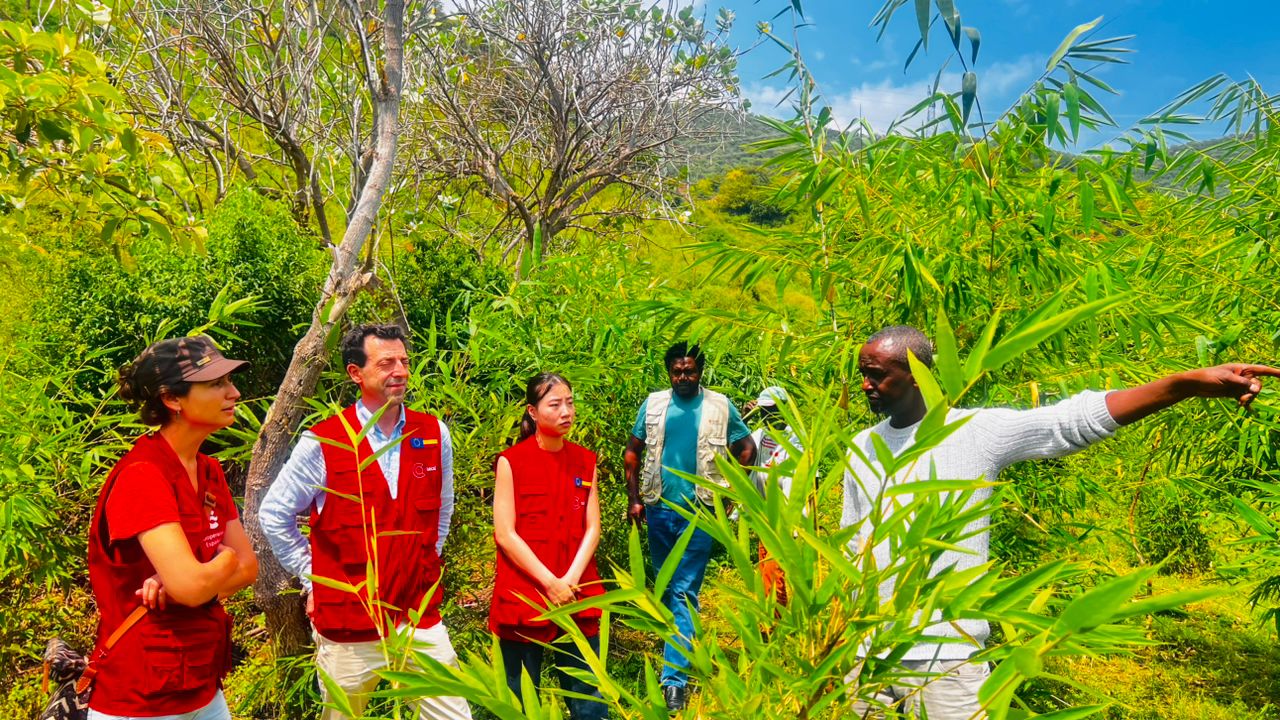
On the final day of the workshop, INBAR WARO organized a field visit to Obogu Community for the Queen Mothers, Ministry of Lands and Natural Resources officials, other participants and media to the Bamboo Common Production and Training Center established under the INBAR and IFAD project, The Inter-Africa Bamboo Smallholder Farmers Livelihood Development, where they were able to experience firsthand the creation of bamboo products and tour an established bamboo plantation near the Center.
On behalf of the Asanteman Queen Mothers Association, H.E. Ms. Nana Difie II expressed her profound gratitude to INBAR, the Ministry of Lands and Natural Resources as well as Forest Plantation Fund Board for organizing such an informative and educational workshop, which has challenged them to embark on a journey of bamboo plantation development.